Quick Travel Tools
 Where US Travelers Need an Adapter (and Where 230V Can Fry Your Devices), 2026
We checked all 199 countries against the US standard: Type A/B plugs at 120V. The result: a plug adapter is needed almost everywhere, and in most countries the voltage is high enough to fry a single-voltage US device if you're not careful.
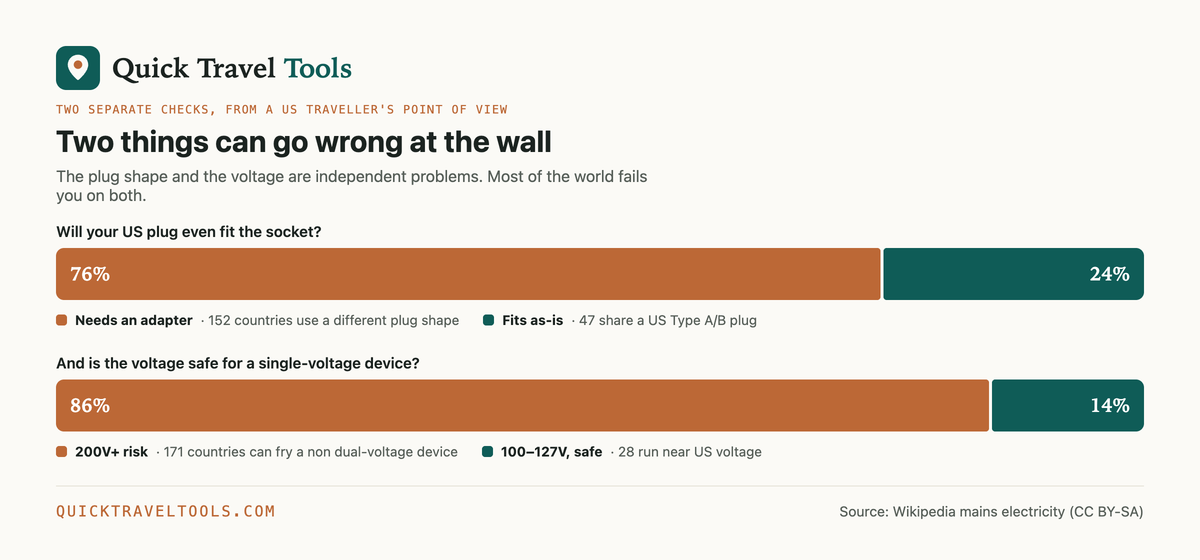
Two things can go wrong at the wall
The plug shape and the voltage are independent problems. Most of the world fails you on both.
Will your US plug even fit the socket?
And is the voltage safe for a single-voltage device?
The two checks are independent. A country can share your plug shape and still run dangerous voltage.
The short list: where a US plug just works
Only 26 of 199 countries let a US traveller plug in with no adapter and no converter. Nearly all of them are in the Americas or the Pacific.
A plug adapter changes the shape so your plug fits the wall. A voltage converter changes the electricity itself. Coming from the US you'll need an adapter in 76% of countries, but the bigger risk is voltage: in the 171 countries running 200V+, a single-voltage device (many hair dryers, straighteners, older electronics) can be destroyed instantly by an adapter alone. Modern phone and laptop chargers are almost always dual-voltage (look for "100–240V" printed on the brick) and only need the adapter.
Each country compared to the US home standard: Type A/B plugs at ~120V. “Needs an adapter” = the country shares no plug type with the US. “Voltage risk” = primary voltage of 200V+, which can damage single-voltage (non dual-voltage) high-wattage devices. “Just works” = shares a US plug type AND runs at 100–127V.
Data: Wikipedia: Mains electricity by country (CC BY-SA 4.0). Analysis by Quick Travel Tools.
Cite this study (free with a link back):
Quick Travel Tools: “Where US Travelers Need an Adapter (and Where 230V Can Fry Your Devices), 2026”. https://quicktraveltools.com/studies/us-travel-adapter-guide-2026/