Quick Travel Tools
 Travel freedom feels like it should be a regional thing, that neighboring countries would open up roughly the same slice of the world. It does not work that way at all.
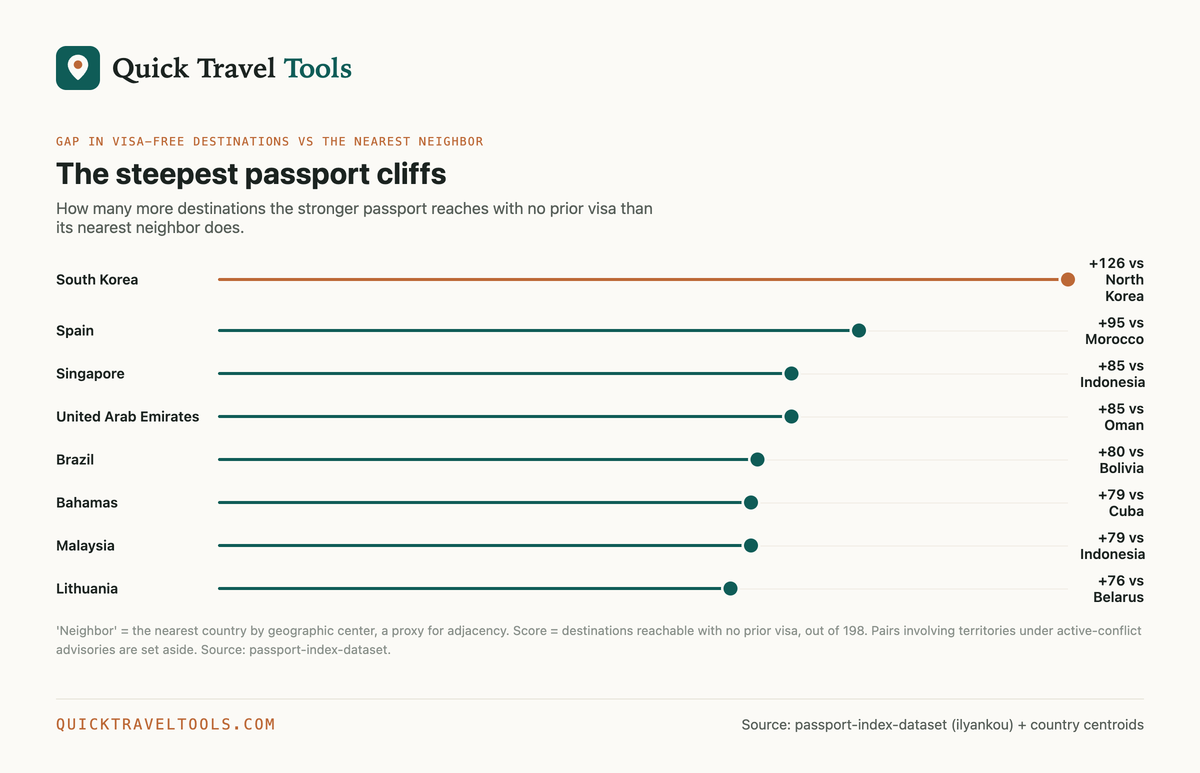
The starkest example sits on one peninsula. A South Korean passport reaches 166 destinations with no visa arranged in advance, one of the strongest on earth. Cross the most fortified border in the world and a North Korean passport reaches 40. Same peninsula, a 126-destination gap.
The pattern repeats across water and desert. Spain opens 95 more destinations than Morocco, a short ferry away across the Strait of Gibraltar. Singapore and Malaysia each reach around 80 more than Indonesia next door. In the Gulf, the UAE outpaces neighboring Oman by 85. None of these gaps are about distance.
They are about relationships. A passport’s strength is built from decades of visa-waiver agreements, which track a country’s wealth, its diplomatic ties, and how much other governments trust its documents and its border controls. Geography barely enters into it, which is why two countries a short hop apart can hand their citizens completely different maps of where they are free to go.
It is a quiet form of inequality: for most people the single biggest factor in how easily they can see the world is not their money or their planning, but which side of a line they happened to be born on.